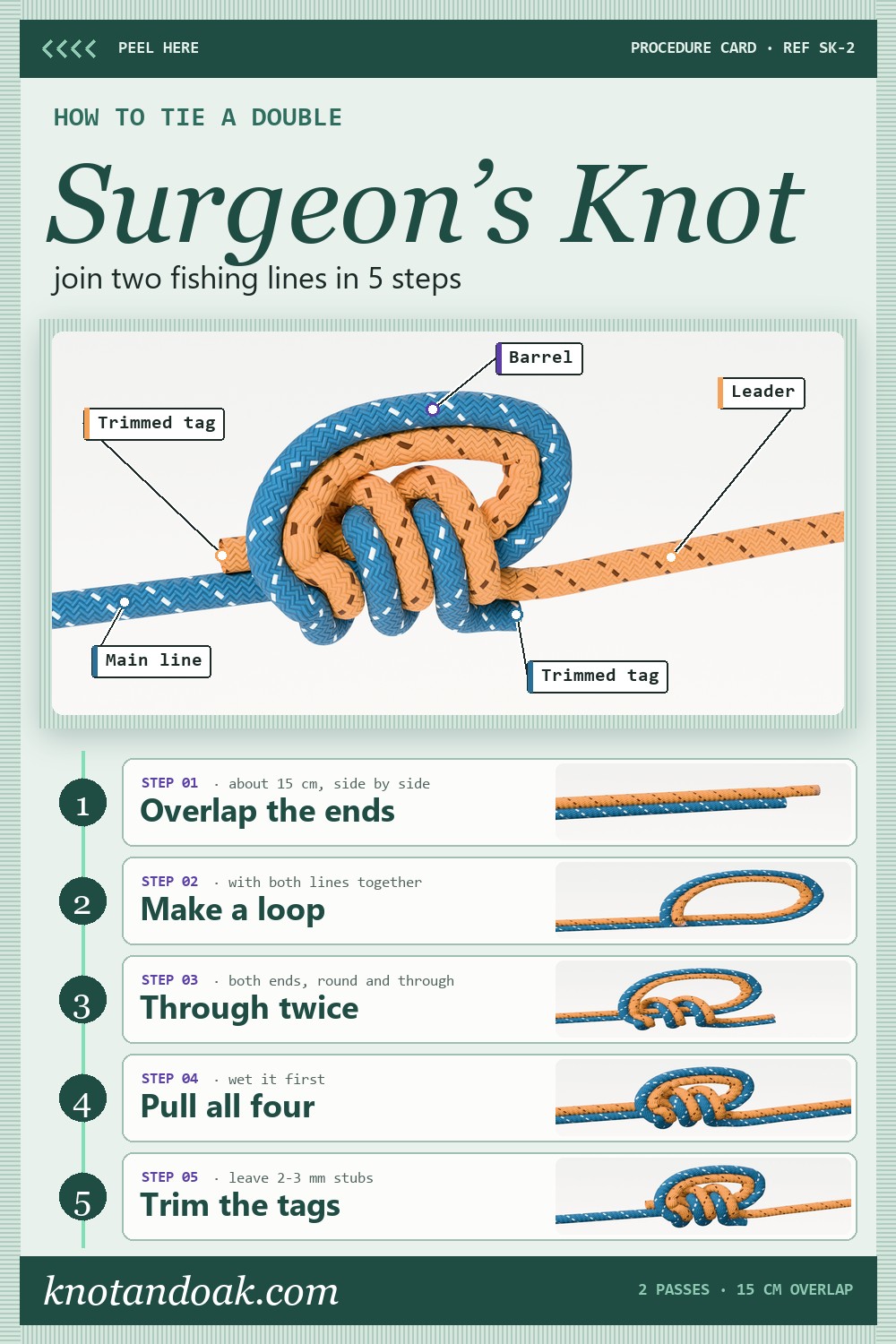
Overlap, loop, through twice, pull all four, trim. Watch it once whole, then take it step by step.
One beat per step · the dot follows the clip
01Pre-op · before you start
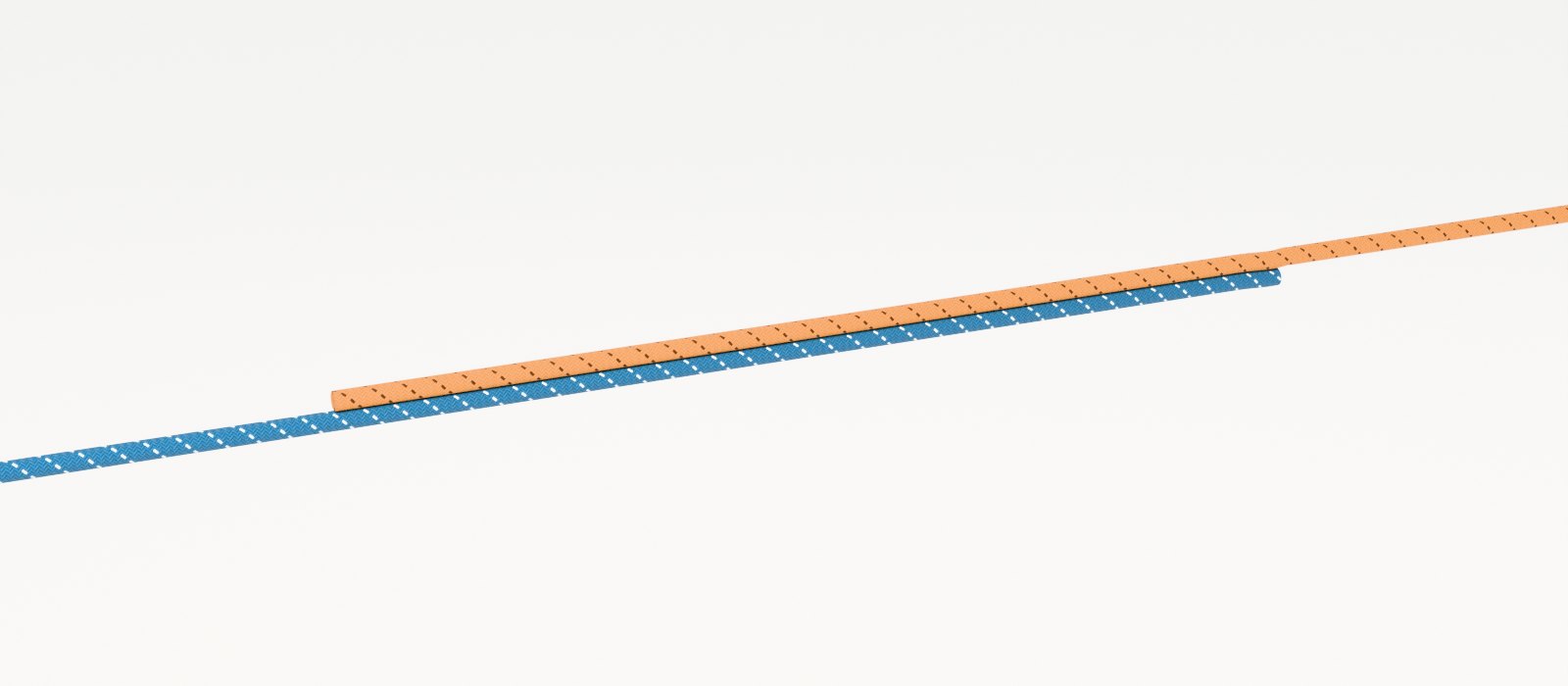
Two lines, side by side
Main lineLeaderOverlap ~15 cm
Fig. 2 · the leader slides in alongside the main line’s end
Same size or not
It joins lines of similar or quite different diameters: tippet to leader, leader to main line.
Overlap about 15 cm
Lay about 15 cm (6 in) of each end side by side, pointing opposite ways. Too short and you run out of tag.
Wet before pulling tight
A little water or saliva lets the turns slide home without friction heat weakening the line.
Pairings
Same size
Tippet to tippet, mono to mono
2 passes
Thin to thick
Tippet to leader, leader to line
2 passes
Slick line
Fluorocarbon or braid in the join
3 passes
02Procedure · each clip loops
Five steps to a double surgeon’s knot
1STEP 01/05 6 S CLIP
Overlap the ends
Lay the end of the leader alongside the end of the main line so they overlap by about 15 cm (6 in), the two ends pointing opposite ways.
NotePinch the overlap between finger and thumb. From here on, treat the two lines as one.
2STEP 02/05 7 S CLIP
Make a loop
Holding both lines together, curl the doubled part up and back over itself to form a loop.
NoteKeep the loop roomy: both ends have to go through it twice.
3STEP 03/05 12 S CLIP
Through twice
Take both ends together round and through the loop, then through again: a double overhand in two lines at once.
NoteThe leader goes through whole, so tie with a short leader or tippet and the main line’s end.
4STEP 04/05 8 S CLIP
Pull all four
Wet the knot, then pull all four strands at once, both lines on each side, so the turns bed down into a neat barrel.
NotePull slowly and evenly. Water cuts the friction heat that can weaken nylon line.
5STEP 05/05 4 S CLIP
Trim the tags
Trim both tag ends close to the knot, one on each side.
NoteLeave a stub of about 2–3 mm (⅛ in), so the ends can’t creep back through.
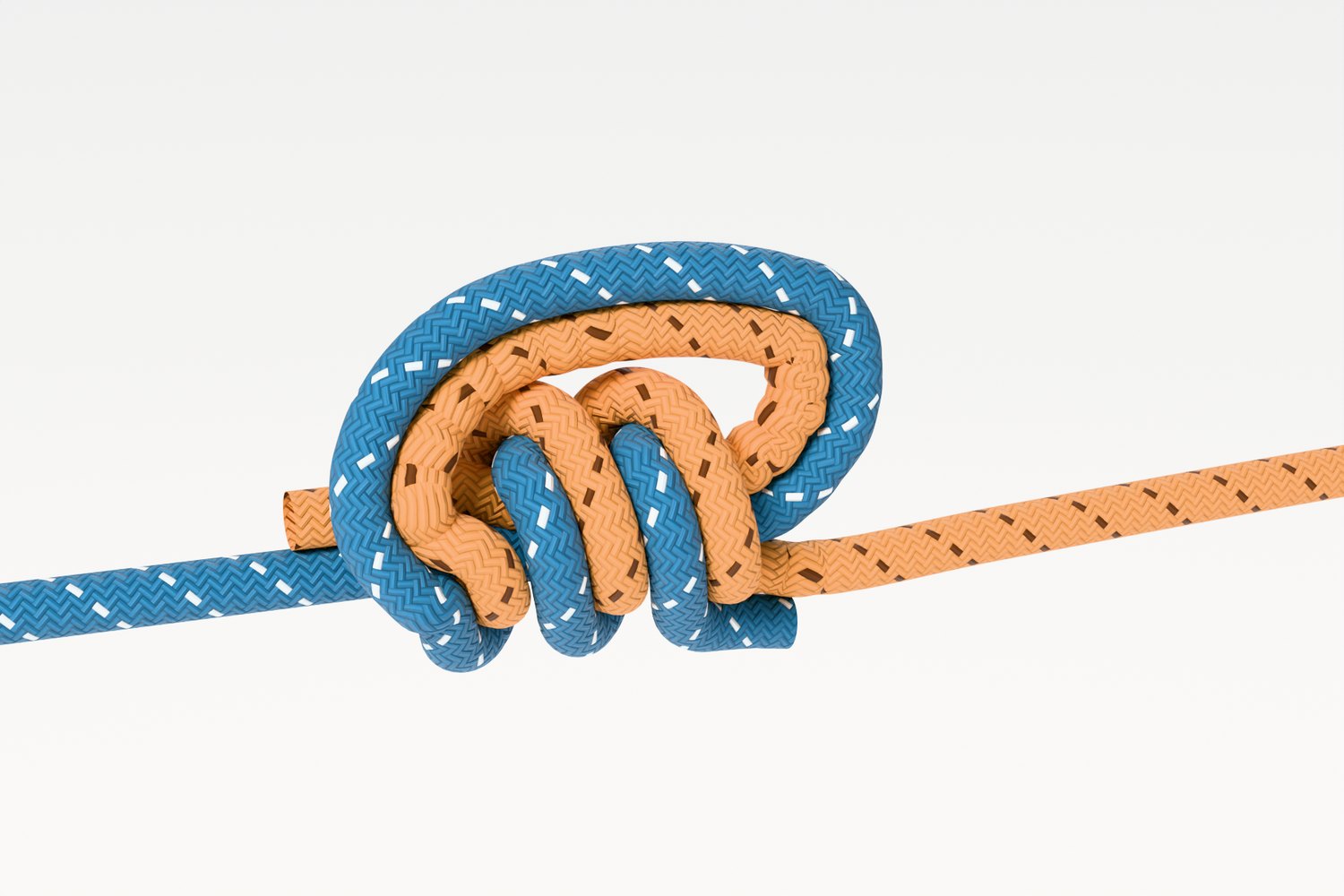
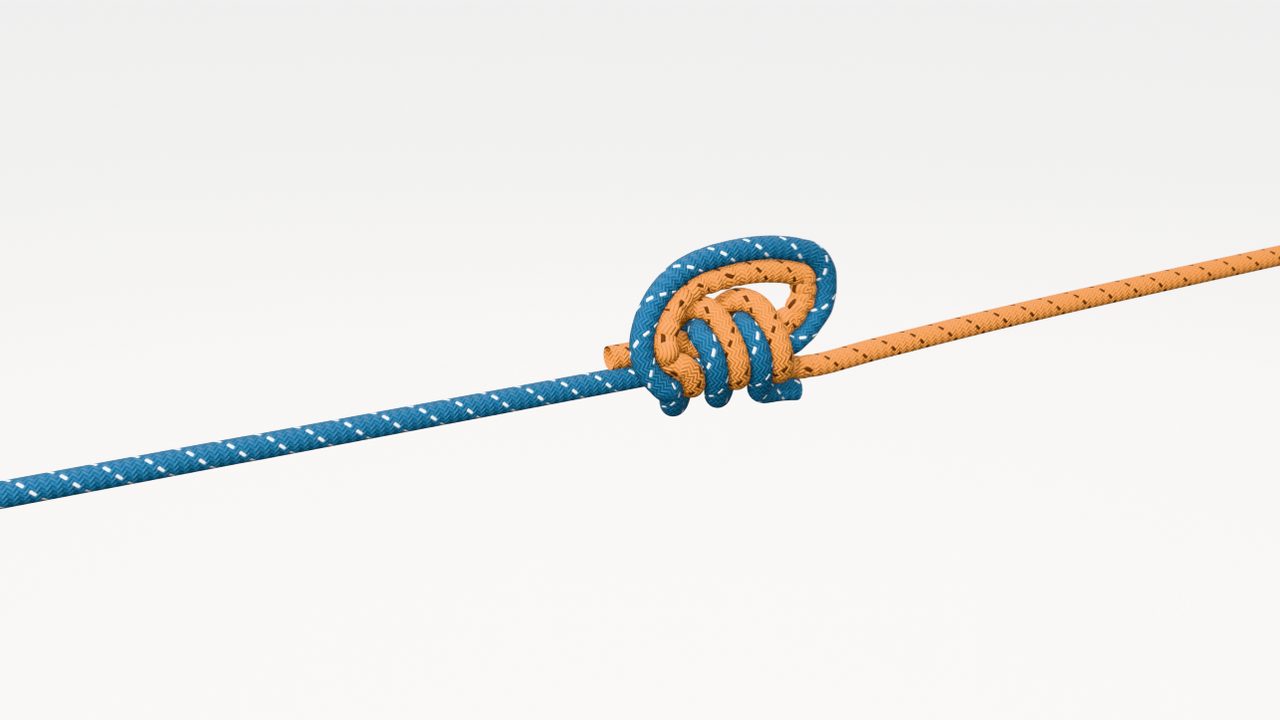
Closed: one barrel, two lines out, two short stubs
03Post-op · check before you fish
Two lines joined in a neat barrel
04Variants · finishing
The triple, and a clean trim
Variant · 3 passes
The triple surgeon’s knot
Tie it exactly the same way but take the ends through the loop a third time. The extra turn gives slick lines more to grip, so the knot doesn’t slip as it is pulled tight.
Double · 2 passesTriple · 3 passes
Use it for fluorocarbon, which is stiff and slippery, and for joins involving braid.
The barrel is a little longer and bulkier; it still passes through most rod guides.
Wet it well: three turns create more friction as they bed down.
Finishing · the tags
Trimming the tags
Only trim once the knot is fully pulled down. Cut both tags, the main line’s on one side and the leader’s on the other, with sharp nippers or small scissors.
2–3 mm stubs, one each side
Leave a 2–3 mm (⅛ in) stub: flush cuts can creep back through under load.
Square, clean cuts don’t snag weed or rattle through the guides.
Don’t burn mono tags: the heat can weaken the knot right beside them.
05Examine · interactive 3D
Examine it from every side
Drag to turn the knot, pinch in on the turns, scrub back to any step, or glow the main line to trace it through the loop.
Live model · SK-2Drag · pinch · scrub
·Drag to turn · pinch to zoom
0:00
06Indications · common uses
Common uses
USE 01
Leader to tippet
Add fresh tippet to the end of a fly leader as it gets cut back.
USE 02
Building fly leaders
Join sections of stepped-down diameter into a hand-tied tapered leader.
USE 03
Mending a broken line
Rejoin a snapped line on the water in seconds, with no tools.
USE 04
Joining two cords
Any two strings or thin cords: kite line, whipping twine, craft cord.
07Take away
Keep the card
All five steps on one card. Pin it, or keep it with your fly box for the next time you add tippet.